Bitcoin Decoded
If you trade crypto and you don't really understand Bitcoin, you're playing a game without knowing the rules. Every alt rally,...
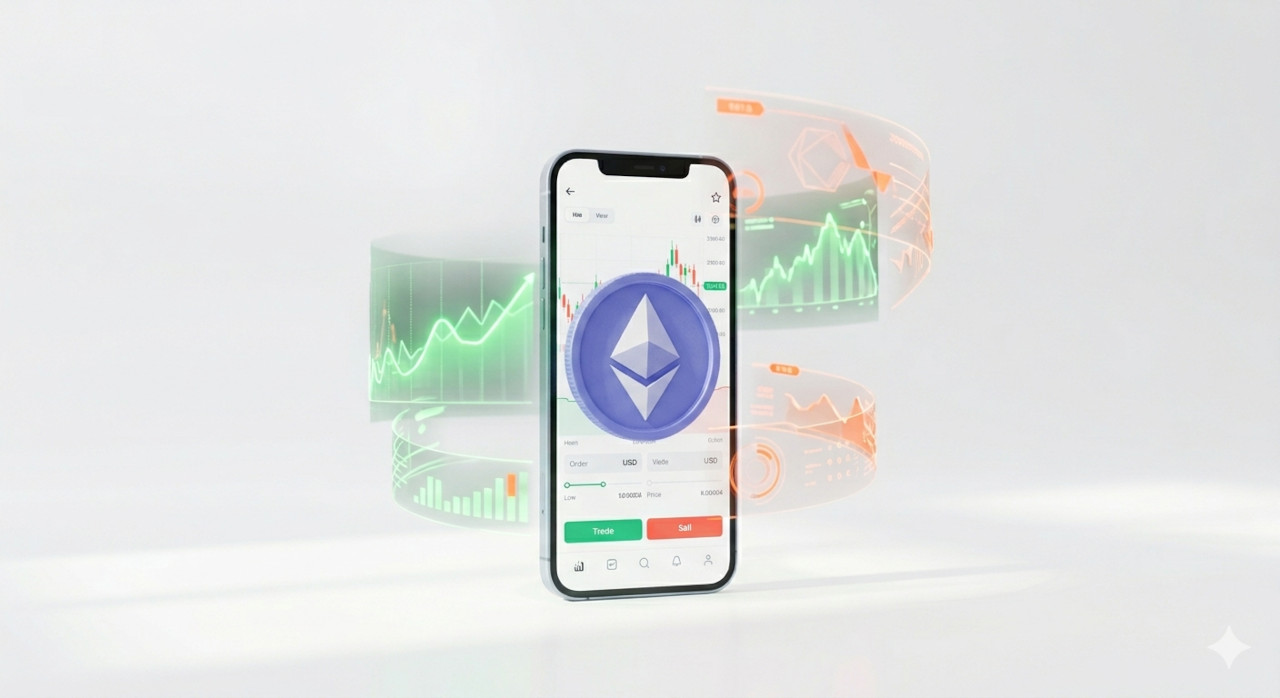
If you have spent any time around crypto charts, you already know that Ethereum is the second name everyone learns after Bitcoin. What is less obvious is just how different ETH actually trades, why those differences matter, and how often traders lose money simply because they treat Ethereum like a slower, cheaper version of BTC. It is not. Ethereum is a different asset, with a different economy, a different user base, and a very different set of price drivers.
For anyone trying to take crypto trading seriously, getting Ethereum right is not optional. ETH is the second largest crypto by market cap, the settlement layer for most stablecoins, the home base of decentralized finance, and increasingly a staple of institutional portfolios through spot ETFs. When ETH moves, it pulls a huge chunk of the altcoin market with it. Misreading Ethereum usually means misreading the broader market.
This guide walks through what Ethereum actually is, what makes its price tick, and how to think about ETH as a tradable asset rather than just "the other big coin."
Ethereum is best understood as two things at once. It is a blockchain network, and it is a programmable computing platform. Bitcoin lets you send and receive digital money. Ethereum lets you do that too, but it can also run open-source programs called smart contracts, which power everything from lending markets to NFT marketplaces to stablecoins.
The native cryptocurrency of the network is ether (ETH). Every action on Ethereum, whether you are sending USDC, swapping tokens, or minting an NFT, requires a small fee paid in ETH. That fee, often called gas, is what keeps the network running and what compensates the validators who process transactions.
A few facts are worth committing to memory:
That last point is one of the most underappreciated aspects of Ethereum from a trading perspective. ETH supply is not fixed like Bitcoin's 21 million cap. It moves dynamically based on usage. When the network is busy, more ETH is burned than created. When activity slows, supply grows slightly. This dynamic supply ties Ethereum's monetary policy directly to real economic activity on the chain, which is a meaningful difference from any other major crypto.
Most newer traders think of Ethereum as one thing: a coin on a chart. In reality, ETH is the bottom of a stack that includes most of crypto's economic activity.
For traders, this matters because Ethereum's price is not just a function of speculative demand. It reflects the health of an entire economy of applications. When DeFi activity surges, when NFT volumes spike, when a Layer 2 has a viral moment, ETH usually feels it. Watching on-chain activity gives you a leading indicator that pure technical analysis often misses.
If you want to trade Ethereum well, you need to understand the handful of drivers that actually move it. They are not all the same drivers as Bitcoin.
Since the EIP-1559 upgrade in 2021, a portion of every transaction fee on Ethereum is destroyed. This means activity directly impacts supply. During periods of intense usage, ETH can become net deflationary. During quiet markets, issuance slightly outpaces burn and supply grows.
Practically speaking, when you see DeFi TVL climbing, gas prices rising, and Layer 2 activity expanding, that is fundamental tailwind for ETH. When those metrics fade, even bullish narratives can struggle to hold price.
Roughly 29 to 30 percent of all ETH is currently staked, with around 35 million ETH locked across over a million validators. That is supply that is not actively trading on exchanges. Staking yields hover around 2.8 to 3.5 percent annually, which gives long-term holders a reason to keep their ETH off the market.
Watch staking flows the same way you would watch any supply indicator. Rising staking participation tightens float. Sudden withdrawals can signal that holders are preparing to sell.
Spot Ethereum ETFs were approved in mid-2024 and have become a major demand channel. BlackRock's iShares Ethereum Trust alone holds well over a million ETH at various points. Combined corporate treasuries and ETFs now control a meaningful percentage of circulating supply.
The catch is that ETF flows cut both ways. Strong inflows have lifted ETH significantly during institutional accumulation phases. Persistent outflows, like the ones seen in early 2026 when ETH dropped from around $3,000 to below $2,000, can amplify selloffs. Daily ETF flow data is one of the easiest, most reliable signals to follow as a trader.
Ethereum is still a risk asset. Interest rate decisions, recession fears, and broader liquidity conditions affect ETH the same way they affect tech stocks, often with higher amplitude. The early 2026 drawdown was not just about crypto-specific issues. It coincided with broader risk-off sentiment, U.S. trade policy uncertainty, and Federal Reserve positioning. Ignoring macro context while trading ETH is one of the fastest ways to get caught on the wrong side of a move.
Ethereum upgrades regularly, and major upgrades tend to reshape the investment narrative. The Merge in 2022 moved Ethereum to proof-of-stake. Dencun in March 2024 introduced proto-danksharding, slashing Layer 2 fees by up to 75 percent. Pectra in May 2025 raised validator caps and improved wallet usability. Upcoming upgrades like Glamsterdam aim to push scalability further.
Upgrades themselves rarely produce clean "buy the news" trades, but they shift fundamentals. A trader who understands what each upgrade means for usage and economics has a better long-term thesis than one who just watches the chart.
Knowing the fundamentals is one thing. Surviving the chart is another. A few patterns show up over and over in Ethereum trading.
In most crypto cycles, Bitcoin moves first and Ethereum follows. Liquidity tends to rotate from BTC into ETH, and then from ETH into mid-cap altcoins. When the BTC-ETH ratio compresses (meaning ETH gains strength against BTC), it is often a signal that the broader altcoin market is about to wake up. When ETH bleeds against BTC, alts usually bleed harder.
This rotation is not a guarantee, but it is a tendency worth tracking. Many traders watch the ETH/BTC pair as a sentiment gauge for risk appetite within crypto.
ETH is less volatile than small-cap altcoins, but more volatile than Bitcoin. Single-day moves of 5 to 10 percent are normal. Drawdowns of 30 percent or more are part of every cycle. ETH set its all-time high near $4,878 in November 2021, then spent two years working back through the $1,000 to $2,000 range, then rallied above $4,000 again, then corrected hard once more.
If your position size cannot survive a 30 percent drawdown without forcing you to sell at a loss, your position size is too big. This is the most common mistake new traders make with ETH. They size based on conviction rather than on volatility, and the chart eventually punishes them.
A few patterns repeat constantly in the accounts of struggling traders:
ETH is an asset that rewards patience and crushes overconfidence. A few principles worth treating as non-negotiable:
None of this is glamorous, but the traders who survive multiple cycles are almost always the ones who treat risk management as the actual job.
Most traders do not have time to monitor on-chain data, ETF flows, macro news, and chart structure all day. This is where structured insights become useful. Platforms like Green Crypto Signals are built to do exactly that: combine market structure, on-chain context, and timing into actionable signals so you can spend less time staring at terminals and more time executing decisions you actually understand.
The right way to use signals is as one input among several, not as a replacement for your own judgment. A good signal tells you what is happening and where the levels are. Whether you take the trade, how much you size, and where you place your stop are still your responsibility. The traders who get the most out of signal services are the ones who use them to filter noise, not to outsource thinking.
If you are still learning Ethereum, the best workflow is usually to pair fundamental understanding (which this guide gives you a starting point on) with consistent insights from a source you trust. Over time, you will start to see how the macro story, the on-chain data, and the chart itself all line up, which is when trading stops feeling like guessing.
Ethereum is not just a coin. It is the foundation of an entire on-chain economy, and the price action reflects that complexity. The traders who do well with ETH are the ones who understand what they are actually trading: a programmable settlement layer with deflationary supply pressure, deep institutional demand through ETFs, and a thriving ecosystem of stablecoins, DeFi, and Layer 2 networks layered on top.
A few takeaways worth holding onto:
Ethereum will keep evolving. New upgrades, new use cases, and new institutional flows will all reshape the chart in ways that are hard to predict. What does not change is the discipline required to trade it well. Understand the asset, respect the volatility, manage your risk, and use the tools and insights that genuinely improve your decision-making. That is how you move from reacting to the market to actually working with it.
September 13, 2025
If you trade crypto and you don't really understand Bitcoin, you're playing a game without knowing the rules. Every alt rally,...
Few events in crypto carry as much weight as the Bitcoin halving. It happens roughly once every four years, lasts about ten...

By the time Q4 2025 wrapped up, Tron had quietly assembled one of the most curious split-screen stories in crypto. The network...
Create your free account and set up in under 5 minutes with our Quick Setup wizard.
 API keys encrypted at rest
 Trade-only permissions, no withdrawal access
 Practice risk-free with testnet mode
No credit card required.