Understanding Bitcoin Halving
Few events in crypto carry as much weight as the Bitcoin halving. It happens roughly once every four years, lasts about ten...
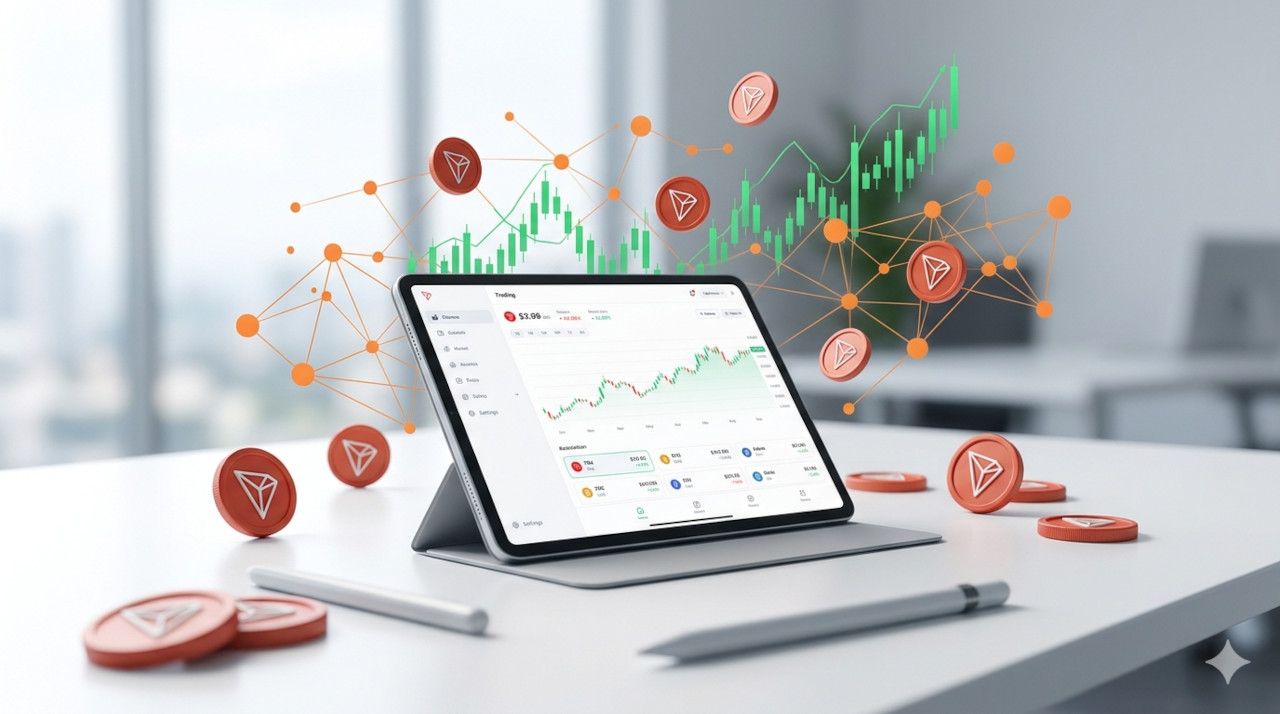
By the time Q4 2025 wrapped up, Tron had quietly assembled one of the most curious split-screen stories in crypto. The network printed more transactions than ever, kept its grip on retail stablecoin payments, and locked in deals with some of the biggest fintech names on earth. And while all of that was happening, TRX itself put together its worst fourth quarter since the token launched back in 2017.
If you trade altcoins, that contradiction is the whole lesson. Q4 2025 on Tron is a textbook example of why "good news on-chain" and "good news on the chart" are not always the same trade. Let's break down what actually happened, what it tells us about how the market is pricing infrastructure plays right now, and what to do with that information as a trader.
Underneath the price chart, Tron had a strong quarter by almost every meaningful measure.
Daily active users averaged around 2.8 million across October through December, up from 2.6 million in Q3. Among the major Layer 1s, only Solana ran higher. Roughly 78% of those users transacted wallet to wallet, the highest peer-to-peer share of any benchmarked chain. That is not speculative on-chain trading or DeFi click-farming. That is people actually moving value.
The headline metric, though, is still stablecoins. Tron handled close to 56% of all retail USDT transfers under $1,000 worldwide in Q4 and finished 2025 with around $82 billion in USDT supply on the network. That is roughly 42% of the entire stablecoin market sitting on a single chain. Total transfer value across the network hit close to $7.9 trillion for the year, with daily USDT transfer volume averaging just under $24 billion in the final stretch.
Throughput numbers were equally aggressive. Tron averaged 10.1 million daily transactions in Q4, peaking at 12.7 million on October 28. Even more telling is the reliability number: a 99% transaction success rate over the year, ahead of Ethereum, BNB Chain, and Solana. While other chains have wobbled under load, Tron mostly just keeps clearing transfers.
Behind the raw numbers, three storylines deserve a closer look.
In December, Tron and Revolut completed an integration that lets all 65 million plus Revolut customers across the European Economic Area stake TRX directly inside the app. No external wallet, no gas management, no setup. Just a click. Revolut takes a 0% platform fee, with only a small validator fee deducted on chain. The integration also added fast stablecoin remittances on Tron and 1:1 fiat to stablecoin conversion across the EEA.
This matters more than most retail traders realize. Distribution has always been the bottleneck for crypto adoption, and Revolut is one of the few consumer fintechs that can put a staking button in front of tens of millions of people who would never otherwise touch a self custody wallet. It is not a guaranteed price catalyst, but it is exactly the kind of slow-burning structural demand that can quietly tighten supply over time as more TRX gets locked.
The mandatory v4.8.1 (Democritus) hard fork was finalized in Q4 and is rolling out to mainnet through early 2026. The big themes are tighter EVM consistency to make Ethereum dApps easier to port over, support for energy efficient ARM hardware, and storage optimizations that lower the cost of running a node. In plain English, Tron is positioning itself to absorb developers and applications that already speak Ethereum's language while staying cheap to operate.
This one flew under the radar. Intent-based transaction volume on Tron surged about 899% quarter over quarter to $449 million, making Tron the third largest intent ecosystem behind only Ethereum and Solana. Add in the Kalshi prediction market integration, Base connectivity through LayerZero, recognition of USDT on Tron as an accepted fiat-referenced token in the Abu Dhabi Global Market, and the first minting of World Liberty Financial's USD1 stablecoin on Tron, and you have a network that is clearly broadening beyond simple USDT transfers.
Here is where it gets interesting for traders. Despite all of the above, TRX fell roughly 16% in Q4, ending the year around $0.27. That was its worst fourth quarter performance since the token launched in 2017. Average daily network fees dropped from $1.2 million in early October to about $975,000 by year end, in line with a broader decline in fees across the sector.
Why did the price fall while the fundamentals strengthened?
A few reasons stand out:
For anyone holding TRX or watching it as a swing trade, this divergence is the entire takeaway. Strong network metrics did not save the price in Q4, and they very rarely do on a one quarter horizon.
Q4 2025 on Tron is genuinely useful as a teaching moment, even if you never plan to touch TRX directly. A few practical lessons:
Network adoption is real and it matters over multi-quarter horizons, but it almost never lines up cleanly with weekly or monthly price action. If you are entering a trade because "users are up and stablecoins are flowing," you are taking a thesis trade, not a setup trade. Plan accordingly: wider stops, smaller size, longer time horizon.
Tron's strongest signal in Q4 was not any single press release. It was the steady rise in retail USDT share, daily active users, and intent volume. Tools that track on-chain flows, stablecoin movement, and active addresses give you a much earlier read than waiting for a quarterly report. Pairing that kind of on-chain context with the trade signals and market insights you already use day to day usually beats picking either one in isolation.
A 60% fee cut is great for users and rough for token holders, at least in the short term. Anytime a network you trade adjusts its fee structure, ask the boring question first: where does that revenue go, and what is the second order effect on supply, burn, and staking yield? The headline often celebrates the upgrade. The chart prices in the math.
This is the most common mistake retail traders make with chains like Tron. "Look at all that USDT volume, the price has to follow" is not an edge. It is a hope. Real users transferring stablecoins do not necessarily need to buy more TRX, and they certainly do not have to mark it up. A network can be wildly successful and still produce a flat or losing token for quarters at a time.
If you are trading TRX into 2026, a few things worth keeping on your radar:
Step back from the chart for a second. Tron in Q4 2025 looks more and more like financial plumbing than a crypto bet. Roughly 350 million accounts, trillions in annual stablecoin settlement, fintech distribution through Revolut, regulatory recognition in markets like Abu Dhabi, and a network that keeps processing transfers when other chains hiccup. That is a real business, even if the token sometimes acts like it is not.
For traders, the right framing is probably this: Tron is one of the most useful chains in crypto and one of the least exciting tokens. Treat it accordingly. Use it for what it is good at, which is moving stablecoins around and earning a modest yield. When you do trade TRX directionally, do it with a clear thesis and tight risk parameters, not because the network just had a great quarter.
The market eventually prices reality. The trick is making sure you are still in business when it does.
January 13, 2026
Few events in crypto carry as much weight as the Bitcoin halving. It happens roughly once every four years, lasts about ten...
If you have spent any time around crypto charts, you already know that Ethereum is the second name everyone learns after Bitcoin....
If you trade crypto and you don't really understand Bitcoin, you're playing a game without knowing the rules. Every alt rally,...
Create your free account and set up in under 5 minutes with our Quick Setup wizard.
 API keys encrypted at rest
 Trade-only permissions, no withdrawal access
 Practice risk-free with testnet mode
No credit card required.